
Dr. Mark Lehner
Dr. Mark Lehner
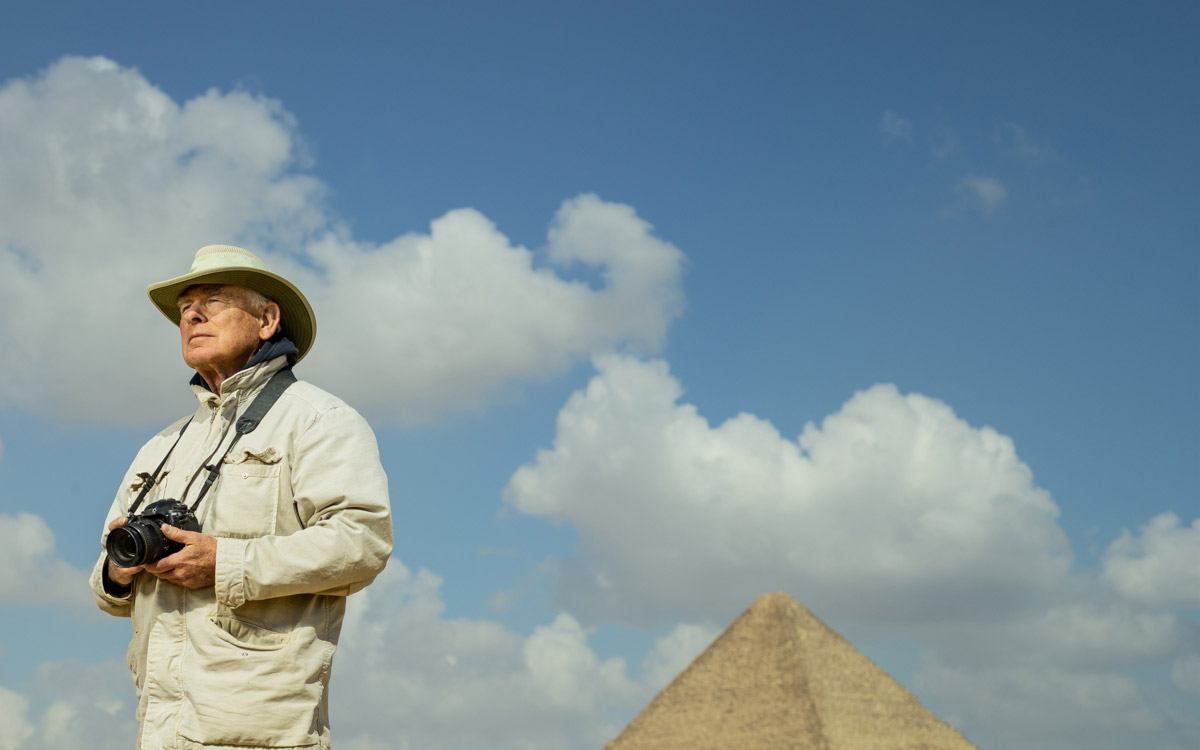
Mark Lehner is director and president of Ancient Egypt Research Associates, Inc. (AERA), an American nonprofit and an NGO registered with the Egyptian government.
His work in Egypt spans fifty years. After earning a BA in Anthropology from the American University in Cairo in 1975, he worked for thirteen years on American, British, French, German and Egyptian archaeological projects in Egypt. He spent five years (1979–1983) mapping the Great Sphinx stone by stone for the ARCE Sphinx Project.
In 1984, he began the Giza Plateau Mapping Project to understand how the pyramid builders organized and transformed the landscape. In 1988, while at Yale working toward his Ph.D., he began excavations in the Heit el-Ghurab site, 400 meters south of the Sphinx at Giza. Also known as the “Lost City of the Pyramid Builders,” Heit el-Ghurab (HeG) is Arabic for “Wall of the Crow,” the local name of the colossal stone wall that forms its northwest boundary. Settlement and infrastructure of the 4th Dynasty (c. 2,600 BCE) pyramid builders extends to the south and east.
Mark completed his Ph.D. at Yale in 1991 and joined the Oriental Institute and Near Eastern Languages and Civilizations department at the University of Chicago. In 1993 he left the tenure track of this position to return to Egypt and save the HeG from urban expansion. To pursue this mission, he established AERA. He remained a research associate of the Oriental Institute, now the Institute for the Study of Ancient Cultures.
AERA grew into one of the largest archaeological missions in Egypt, with its own research center two city blocks from the Giza Plateau. AERA excavations have uncovered 10 acres of 4th Dynasty settlement at HeG, a proto-city that housed pyramid builders and served as a major Nile port of its time. Teams have excavated workers’ barracks, granaries, bakeries, scribal offices, cattle corrals, and harbors.
AERA continues to sponsor annual excavations of the HeG with an international, interdisciplinary team of professional archaeologists, surveyors, geologists, geochronologists, botanists, and faunal specialists. To investigate the larger context of settlement at the southeast base of the Giza Plateau, AERA also excavates the Menkaure Valley Temple and Khentkawes Town. These combined settlements flourished as people abandoned the HeG. They take the settlement record at Giza to from the high Old Kingdom to its end in the 6th Dynasty.
As they salvaged and investigated these settlement sites, Lehner and AERA created a comprehensive field school program for young Egyptian archaeologists of the Ministry of Tourism and Antiquities. Sponsored by the American Research Center in Egypt (ARCE), the schools trained beginners through advanced students in excavation, salvage, analysis, and publication. Between 2005 and 2018, AERA Field Schools trained more than 350 Egyptian archaeologists working as Inspectors for Egypt’s Ministry of Tourism and Antiquities in the best practices of scientific archaeology at Giza, Luxor, and Memphis.
AERA’s work has been featured in National Geographic, Discover, Archaeology, The New Yorker, Smithsonian, and the New York Times, and in documentaries by National Geographic Explorer, Discovery, BBC, and NOVA.